


A multitrillion-dollar industry, B2B marketplaces are growing and here to stay. Omdia predicts that hyperscaler marketplaces – a significant subset of B2B marketplaces – will transact $45Bn in 2025 (1). And that’s precisely why we chose this topic for our recent referrers’ luncheon, which (curiously to us anyway) is not often in the spotlight.
A number of us are using B2C marketplaces, but the rapid rise of digital buying in B2B and the growing influence of large-scale marketplaces like those offered by AWS and the other hyperscalers (large-scale cloud service providers) are too important to ignore. They’re not only reshaping procurement but also changing the way buying and selling happen.
To kickstart the conversation, our Co-Founder and Executive Director, Brett Bonser, opened the event with a look back at the origins of marketplaces – from the Greek agora to the Roman forum – as the foundation of trade, prosperity and social order. Citing French economist Frédéric Bastiat, “When goods don’t cross borders, soldiers will,” he reminded us that exchange has always underpinned stability and progress. Marketplaces have long been more than a space for commerce – they’re the systems that keep societies moving.
What is a marketplace?
A marketplace is a physical or digital platform where businesses sell to individual customers. And a B2B marketplace is an online platform facilitating transactions between businesses.
Why use a B2B marketplace?
The main reason to use a B2B marketplace is simple: it adds another sales channel.
Used effectively, the right platform can reshape how a B2B business sells and scales. Used without clear purpose or alignment, it can consume time, money, and resources without delivering real value.
Choosing the right approach depends on what you sell, how you sell it, and the role a marketplace could realistically play in your growth. There’s no one-size-fits-all answer – but understanding the landscape helps you make an informed decision.
From B2C to B2B Marketplaces
Our Founder and CEO Hugh Macfarlane began the presentation with a simple premise: In every marketplace, “buyer meets seller, and a transaction happens.” But what’s different between marketplaces is why each party comes to it and what happens when they get there.
He first compared the well-known B2C marketplaces, highlighting how platforms we all know have reshaped consumer behaviour and transaction value:
- Etsy: $13B (2)
- Facebook Marketplace: $30B (3)
- eBay: $75B (4)
- Amazon.com: $638B (5)
Then he shifted the lens to B2B – those built around established trade and those powered by cloud ecosystems (the hyperscalers).
Established marketplaces
- Amazon Business: 6 million active customers generating $35B in annual sales –businesses buying from businesses (6)
- SAP Ariba Network: 761 million transactions worth $6T a year – technically a procurement network, but operating at marketplace scale (7)
Hyperscaler marketplaces
- AWS Marketplace
- Azure Marketplace
- Google Cloud Marketplace
Together, these cloud-based platforms generated $16B in 2023, and are projected to reach $85B by 2028 (8).
Value per user: the marketplace multiplier
The stats help paint a picture, but what matters to us is the value of each buyer. So Hugh stacked the platforms by average spend per user to show how value increases from consumer to business marketplaces.
At the low end sits Facebook Marketplace, at around $37 per user, where the Marketplace for Facebook is an add-on to a social media platform. Etsy, where the marketplace is the only thing, enjoys revenues per user of triple that of Facebook Marketplace. And from there, the value per user triples again for eBay, again for Amazon.com, and again for Amazon Business.
Then value per user reaches escape velocity to 10x where we reach Amazon Marketplace and another 10x until we reach SAP Ariba Network, with around $600K per user.
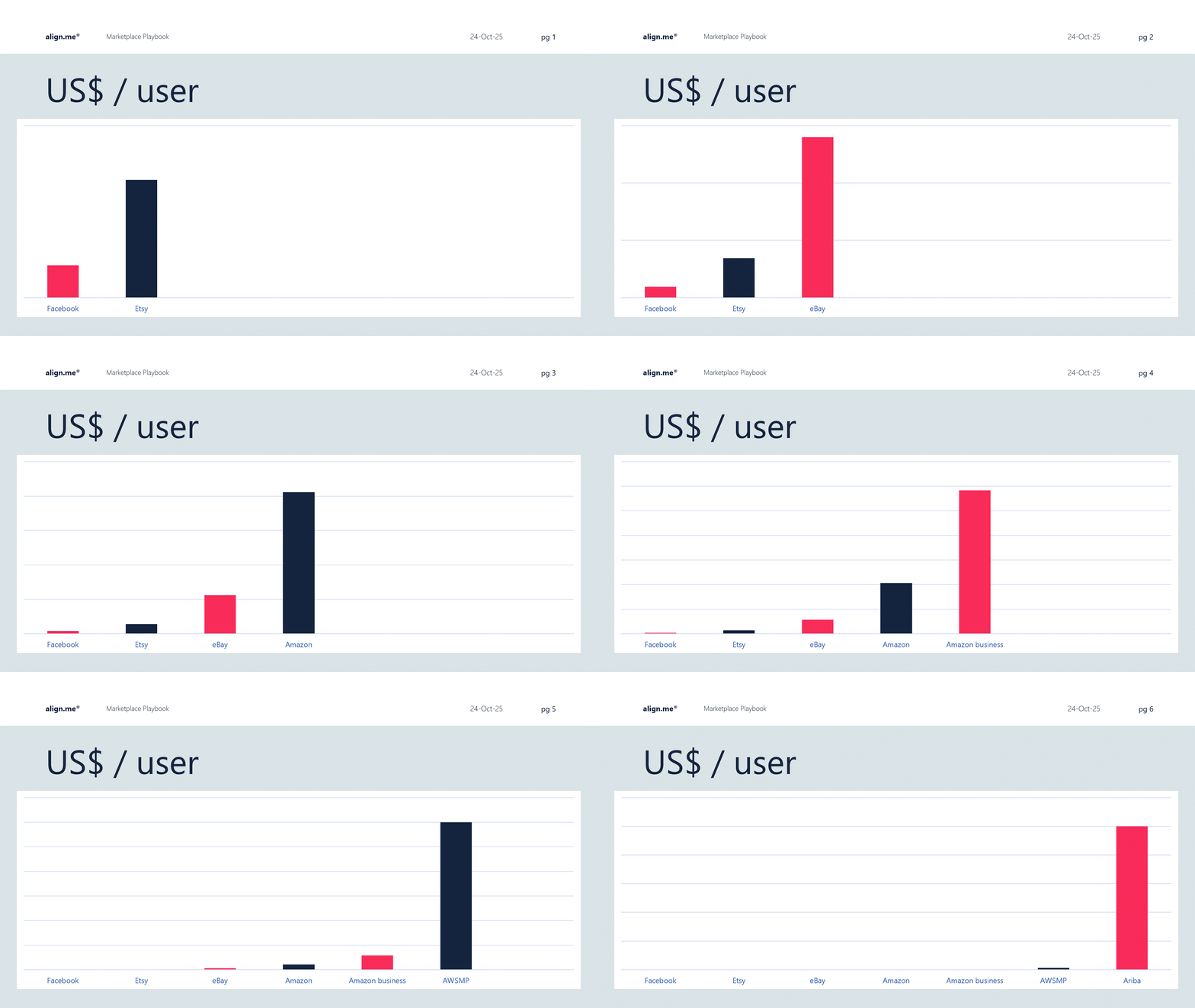
The key takeaway is that as marketplaces evolve from personal to professional, the value of each participant rises dramatically. It’s not about the number of users, but the scale and sophistication of their transactions.
Why do businesses sell via marketplaces?
In a study prepared by Forrester for AWS (9), software vendors reported:
- 80% larger deal sizes
- 40% faster sales cycles
- 27% higher win rate
Sellers are also motivated to reduce margins shared with channel partners. Marketplaces create a more direct commercial path – by transacting through a marketplace rather than traditional resellers or distributors, vendors can retain more of their margin while still meeting buyer procurement standards.
Despite this, Omdia has predicted that 50% of all hyperscaler volume will be led by partners by 2027, suggesting that sellers will continue to be happy to forgo margin for value add like sales, finance, vendor consolidation, and allied services provided by resellers and distributors.
Why do businesses buy (so much) via marketplaces
We know why sellers sell, but why do buyers buy? Here’s how Hugh explained it:
1. Find suppliers
This is the most obvious but arguably least significant reason. Buyers already know who they want to buy from – the marketplace simply provides the mechanism to make that transaction happen.
2. Consolidated billing
Organisations deal with a large number of suppliers, each with its own separate contracts, invoices and payment terms. Buying through marketplaces streamlines this by acting as a single supplier of record – one invoice, one payment process.
3. Meet volume obligations
Many buyers have negotiated agreements that can include their marketplace purchases. AWS calls these Private Pricing Agreements (PPAs), where enterprise buyers commit to spending a minimum annual amount in exchange for commercial benefits such as discounts or support. Up to 25% of that spend can be fulfilled through AWS Marketplace. This allows buyers to meet their contracted spend targets while still purchasing from the independent software vendors (ISVs) they prefer.
4. Gain granular procurement control
Marketplaces enable buyers to maintain detailed control over their purchasing – including who can buy, what they can purchase, and how much they can spend. They also provide visibility and audit trails that make spend management more transparent.
Build it and they will…
… largely not notice you.
To close the presentation, Hugh brought up the film Field of Dreams, the one with the famous line “If you build it, they will come” (if you haven’t watched it yet, consider your weekend plans sorted).
But in B2B, unlike B2C, the most important dynamic is not buyer finds seller, it’s the reason why the buyer and seller are choosing to work through marketplaces.
Marketplaces remove friction for buyers, but for sellers, they do not solve visibility on their own (no ‘field of dreams’). To be found, most sellers still have to invest in the same level of sales and marketing.
Hugh distinguished between two kinds of motions:
Product-led growth (PLG)
Successful sellers need to invest in:
- Marketplace – optimisation of both listing and search, including paid links within the listing platform (if available)
- Links – backlinks and paid listing on review sites like G2, Capterra and GetApp
- Search – SEO and paid search campaigns
- Social – engaging content and display advertising
Enterprise sales
Here, the motion looks more like a standard array of B2B sales and marketing:
- Co-sell – working with vendors, channel partners and marketplace operators
- Account-based marketing (ABM) – focused outreach to key accounts
- Outbound campaigns – targeted outreach and relationship building
- Inbound tactics including display ads to stay visible within key accounts
Together, these highlight the reality of B2B marketplaces – success isn’t about turning up, it’s about being seen.
Inspired by the presentation, long-time member of our network, board advisor Howard Wigham raised the example of Yume – a marketplace that connects manufacturers with buyers to resell surplus food inventory that would otherwise go to waste. Unlike hyperscaler marketplaces, Yume operates independently, working hard to create demand and facilitate transactions that wouldn’t exist otherwise. It’s a powerful reminder that marketplace innovation isn’t limited to tech giants – the same principles of visibility, control, and commercial efficiency can transform even traditional industries.
This was a great segue into our workshops, where the group put their thinking caps on and, as always, came up with very insightful ideas.
Group discussions
After Hugh’s presentation, it was over to you. Our guests broke into four groups to discuss two key questions:
First, we explored strategy, “For which customers (and for which products or services) could marketplaces play a role in your business?”
- One key theme was that government buyers tend to prefer discrete offers (workshops or frameworks) over bundled ones, though marketplaces could make it easier to access and manage both.
- Another was the shift from fixed specifications to customised offers. While many marketplaces began with rigid product definitions, a degree of flexibility is now emerging – allowing for more tailored solutions.
- There remains a tension between commoditised and custom offerings, particularly whether more specialised products (for example, adhesives for wine labels) can realistically find a place in a marketplace model.
- The growing need for co-selling was also highlighted – where vendors, partners and marketplace operators collaborate to reach and support customers more effectively with highly customised products.
In conversation with NEXTGEN’s John Walters, Hugh also touched on some of the more complex mechanics that come into play in mature marketplaces – particularly within AWS. These included:
- Using existing marketplace contracts – for example, government buyers can transact through AWS Marketplace by appending specific terms to a pre-approved contract rather than creating new agreements from scratch
- The designated seller of record (DSOR) model, where authorised distributors can transact on behalf of software vendors
- The challenge of bundling multiple enterprise solutions that require extensive co-selling before being procured
- The use of AWS credits, where large organisations seek guidance on how best to allocate their committed spend
The second workshop shifted focus from what we sell to how we buy to “How should you leverage marketplaces (for both serving existing customers and acquiring new ones)?”
- One idea that emerged was how marketplaces fit into the buyer’s journey for both existing and new customers. They can help bridge a service gap, providing a channel for offers that sit between discrete, custom offers and more standardised bundles.
- Another theme was how marketplaces can streamline the buying experience – making procurement faster and simpler once a deal is already in place. This was likened to last-mile delivery – removing friction at the point of transaction while maintaining the structure and governance buyers need. The trend is being driven by customers, who increasingly expect suppliers to transact through marketplaces to make purchasing easier on their side.
- It was also noted that while a frictionless experience is appealing, it can sometimes feel less human, and that preferences for purchasing entirely online or not can vary across demographics and sometimes friction actually adds value.
- The suitability of marketplaces for complex or early-stage offerings was also discussed. While they can support the final stages of a transaction – handling documentation and governance requirements – tailored solutions often still rely on co-selling or partner engagement to shape and deliver the right outcome. Margin compression was also raised as a potential concern when products are publicly listed.
The key takeaway from this discussion was that marketplaces don’t just simplify existing transactions – they can also create new ones, generating fresh economic momentum. Brett connected this idea to Geoffrey Moore’s chasm theory, noting that marketplaces often accelerate during the ‘tornado’ phase of adoption, when industries shift from direct to indirect selling to meet scale. Long-time friend of align.me, Decoda’s Director George Spink, added that before reaching that stage, buyers tend to stay close to original vendors to refine evolving products, a reminder that while marketplaces drive reach and efficiency, the human connection between buyer and creator still matters most early on.
To sum up
In closing, Hugh remarked, “I expected to learn more than I expected to share, and it was true to an even greater extent than I had hoped.”
Bringing the session full circle, Brett reflected that marketplaces have always been economic accelerators. But in the digital era – especially in B2B – success takes more than simply showing up. There’s no one-size-fits-all solution. To succeed, you need to make use of every channel, partnership and opportunity available.
A big thank you to everyone who attended
Thanks to our guests and the insights shared, this Referrer’s Lunch was a real success. While the future of marketplaces is still taking shape, one thing was clear from our discussions: it’s time to start exploring how they fit into your business.
Sources
(1), (8) https://omdia.tech.informa.com/insights/2025/now-and-next-for-hyperscaler-marketplaces
(2) Etsy, Etsy, Inc. Overview – Key Figures, 2024. Metric: Gross Merchandise Sales (GMS). Value: USD 12.6 billion
(3) Electro IQ, Facebook Marketplace and Shops Statistics By Country, Seller, Demographics And Market Share (2025). Revenue projection (Meta does not publish GMV). Value: USD 30 billion (2024, estimated)
(4) eBay Inc. Reports Fourth Quarter and Full Year 2024 Results. Metric: Gross Merchandise Volume (GMV). Value: USD 74.7 billion
(5) Marketplace Pulse, Amazon Net Sales 1996–2025. Metric: Net sales (proxy for buyer spend – Amazon does not publish GMV). Value: USD 637.96 billion (FY 2024)
(6) https://www.supplychainbrain.com/articles/42373-amazon-business-tops-35b-in-sales
(7) https://www.sap.com/products/business-network/what-is-sap-business-network.html
(9) https://pages.awscloud.com/awsmp-report-mul-forrester-partnertei.html
Author - Hugh Macfarlane
Hugh Macfarlane is founder and CEO of align.me. He's the author of 'The Leaky Funnel', and hundreds of video blogs, papers and ebooks and a handful of research reports on all things alignment.